It’s fun to watch Blake Lively and Henry Golding as an ex-couple again. This time on the beautiful island Capri. During the film we listen to English and Italian.
But: there’s a mistake in a written translation.
Stephanie discovers her book in the Italian version in a local book shop.
The title says “BLONDA” instead of “BIONDA”. 🤔 Why didn’t they check with an Italian? ☀️
My students from Chicago, who currently study German in Vienna, asked me a good question last week:
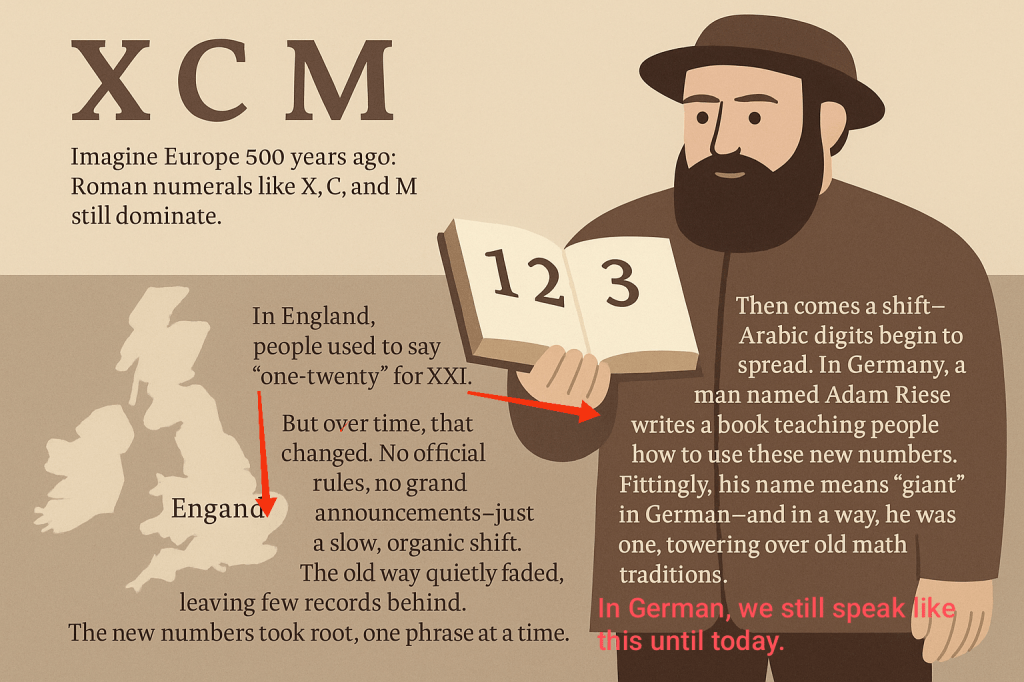
Why are the spoken numbers of two digits all “turned around”?
27 is “siebenundzwanzig” (seven and twenty)
56 is “sechsundfünfzig” (six and fifty)
The answer is: It was like that practically everywhere in Europe, we are just old fashioned!
A bit of language history – English amd German
In English, numbers like one-twenty existed,too, and the transition to the new system proceeded naturally and slowly, as a few records show.
There is still use of the old system for the numbers from 11-19, and in Italian from 11-16.
While Norway officially changed the way of speaking numbers about seventy years ago, the German language kept the “turned around numbers” until today.
“Neun mal sieben istdreiundsechzig.” (9*7=63)
You can find the corresponding newspaper article in German here. The author also talks about intentions of a mathematics professor at that time to change the German way of speaking numbers, in order to facilitate learning and counting.
That’s it for this week. Thank you for reading me.
Do you have a question about German? Don’t hesitate letting me know.
My name is Barbara, I am a German and Italian lecturer at university in Vienna, Austria.
I am very excited to start this new blog about languages.
Are you a fan of linguistics, intercultural friendships, word games and literature? Well, you found the right place.
Every Sunday, there will be a new text on this blog — from the linguistic oven. Come back, subscribe and don’t hesitate letting me know about your experiences with languages and language learning.



 Running Words