Traditionally, learning German means that in your first or second lesson you will learn “Guten Morgen”, “Guten Tag”, “Guten Abend” and – only before going to sleep, unlike in Portuguese and Spanish – “Gute Nacht”.
A little grammar excursion: Nacht has a feminine article in German. But why “guten Tag” and not “gut-er Tag”? Welcome to the accusative. When saying this greeting, it is thought along: I wish you a good day. Day is masculine in German, so it has to be alteredin the accusative.
However, if you enter a store or restaurant in Austria, you are very likely to hear the somewhat old-fashioned “Grüßgott” (greet God) – or colloquially “Hallo”, dialectal “Griaßdi”. If you are going to leave the place, you may choose between “Tschüs” or “Ciao” and he formal “Auf Wiedersehen” (like in Italian “Arrivederci” – a formal ‘See you!’)
“Servus” is how I am greeted in many places in Munich, Germany. It sounds familiar and like home to me, but I also have to smile. In Austria, I would normally only say it to people I’m on a first-name basis with. After all, “Hallo” is the more common informal greeting for my circle of friends. But in Bavaria, “Servus” (from Latin) is a formal greeting too. From my early childhood days, I remember my friend’s mother shouting angrily: “You don’t say hello to grandpa!” (But servus?)
My Viennese “Baba“, which sounds similar to bye bye, is only heard by people close to me when I say goodbye.
Baba ihr (you all)— until next Sunday!
New: The pronuncation of the German words in this text
PS: Have you or your kids started learning German? If music helps you studying, you could sing with.
It’s fun to watch Blake Lively and Henry Golding as an ex-couple again. This time on the beautiful island Capri. During the film we listen to English and Italian.
But: there’s a mistake in a written translation.
Stephanie discovers her book in the Italian version in a local book shop.
The title says “BLONDA” instead of “BIONDA”. 🤔 Why didn’t they check with an Italian? ☀️
A young student from Aachen, Germany, was sitting in the gondola to Oberbozen, South Tyrol. She said to her fellow students: “They always think I’m on vacation here because of my High (meaning standard) German.” I suppressed the urge to explain to her that what she was speaking was not standard German either. Many people around the world are of the opinion that in Germany people speak completely unmarked standard language, whereas in the rest of the German-speaking world they communicate in yodelling. In her defense, it should be mentioned that the young student herself is also confronted with prejudices for linguistic reasons when she is basically mistaken for a tourist.
“High German” is intended to mean standard language. In linguistics, the term “High German” is not used in this way, as it means something different in terms of linguistic history. As far as dialects are concerned, a geographically-motivated designation was chosen in linguistic history. A distinction is made between Middle and Upper German (together High German, “high up on the mountains”) and Low German (where it is flat, meaning mainly Northern Germany).
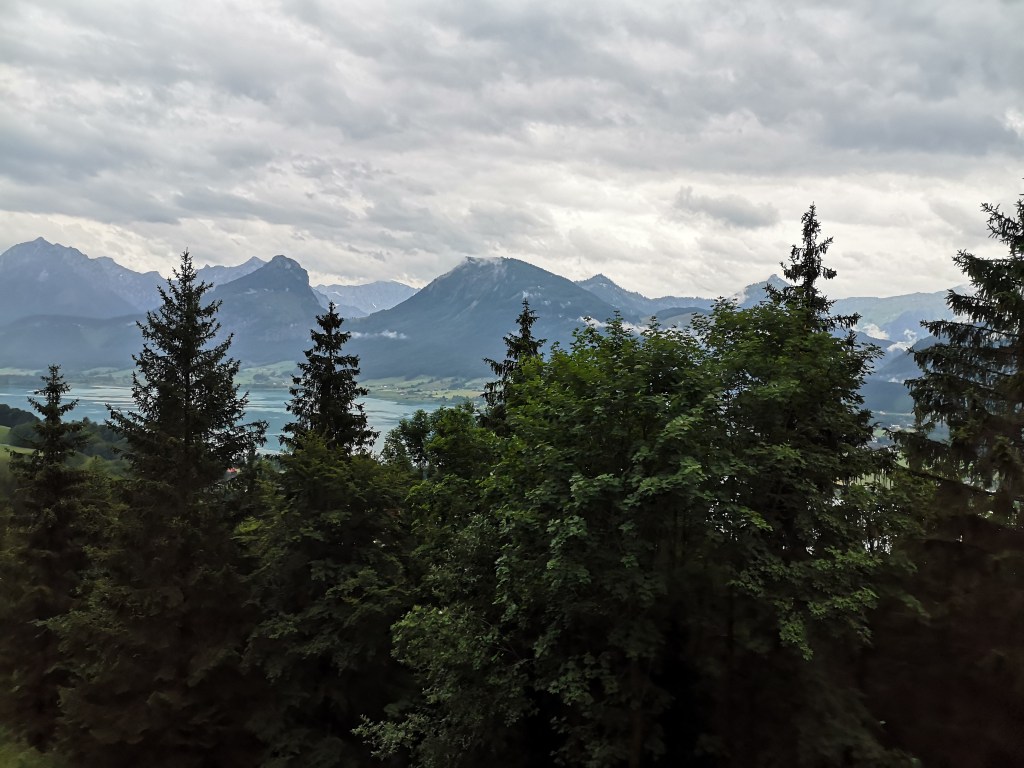
Lake and mountains in Austria.
Now the student in the gondola was of the opinion that she was speaking High German, i.e., the standard language, but this was not the case. She also speaks in the “colloquial language” of her region. Like many people, she believes in a homogeneous standard and the possibility of accent-free pronunciation. Only a handful of people, such as presenters and actors, speak what we think of as standard language: with a prescribed, codified pronunciation.
Yodelling on the mountains? Not quite – there is more than just one standard German
Standard German is hardly ever spoken. And there is not just one. In the newspaper or on television news, you can recognize differences depending on the country. The s in sun (“die Sonne”) in the Austrian weather report sounds different from the one in Germany. Nevertheless, in all German-speaking countries and regions, it is always standard language or what is supposed to come close to it. In fact, there are different standard varieties and we speak of pluricentricity in German. By the way: South Tyrolean German is also a standard variety of pluricentric German.
There are standard language differences between the countries, especially in vocabulary. In 2004, a dictionary of the geographical varieties of the German language was published for the first time. This dictionary of variants, which covers Austria, Switzerland and Germany as well as Liechtenstein, Luxembourg, East Belgium and South Tyrol, has since been supplemented with entries on the German language areas in Romania, Namibia and Mexico.
In addition, there are also grammatical differences or preferences in how we form a sentence. Let’s see how to say: “I was sitting in the gondola.”
In Austria, they say “Ich bin in der Gondel gesessen/gestanden.“ (perfect tense, „be”)
In Germany, they say „Ich habe in der Gondel gesessen/gestanden.“ (perfect tense, „have“)
If you would like to learn German, don’t worry: students would only notice any difference in written German at a high level. What’s more, modern textbooks nowadays follow the DACHL (standing for Germany, Austria and Switzerland/Liechtenstein) principle, which takes all German-speaking countries into account.
My students from Chicago, who currently study German in Vienna, asked me a good question last week:
Why are the spoken numbers of two digits all “turned around”?
27 is “siebenundzwanzig” (seven and twenty)
56 is “sechsundfünfzig” (six and fifty)
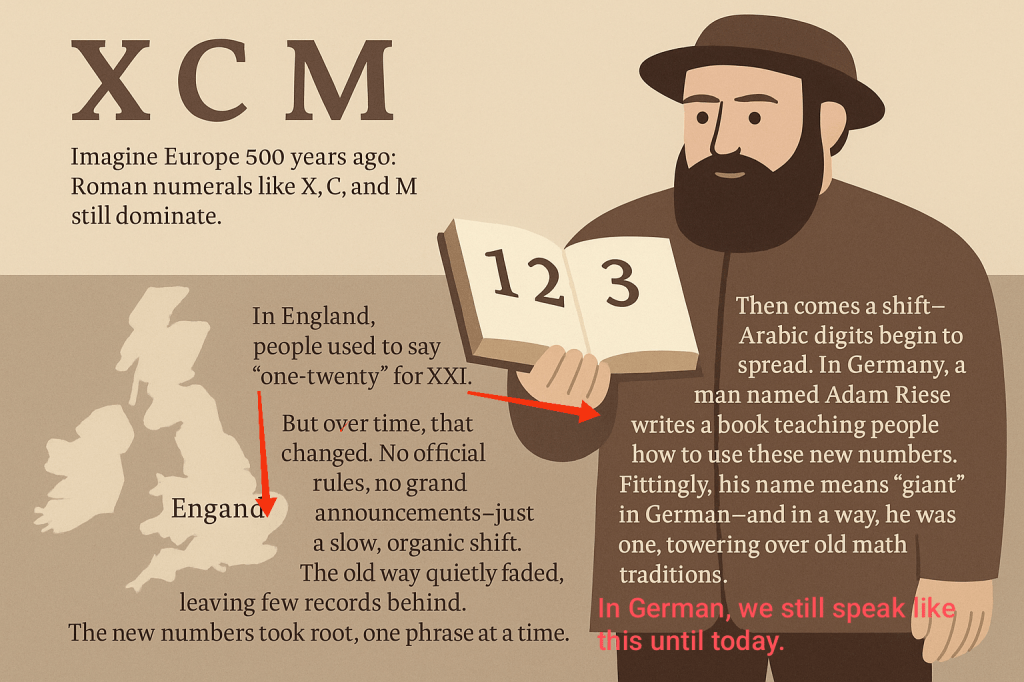
The answer is: It was like that practically everywhere in Europe, we are just old fashioned!
A bit of language history – English amd German
In English, numbers like one-twenty existed,too, and the transition to the new system proceeded naturally and slowly, as a few records show.
There is still use of the old system for the numbers from 11-19, and in Italian from 11-16.
While Norway officially changed the way of speaking numbers about seventy years ago, the German language kept the “turned around numbers” until today.
“Neun mal sieben istdreiundsechzig.” (9*7=63)
You can find the corresponding newspaper article in German here. The author also talks about intentions of a mathematics professor at that time to change the German way of speaking numbers, in order to facilitate learning and counting.
That’s it for this week. Thank you for reading me.
Do you have a question about German? Don’t hesitate letting me know.



 Running Words